

Week by week · 16 weeks · 12 projects
What they build, when.
Weeks 1–4PYTHON FOUNDATIONS
Turtle Art + First Programs
Draw shapes, spirals, patterns. Variables, loops, functions — the real vocabulary of code.
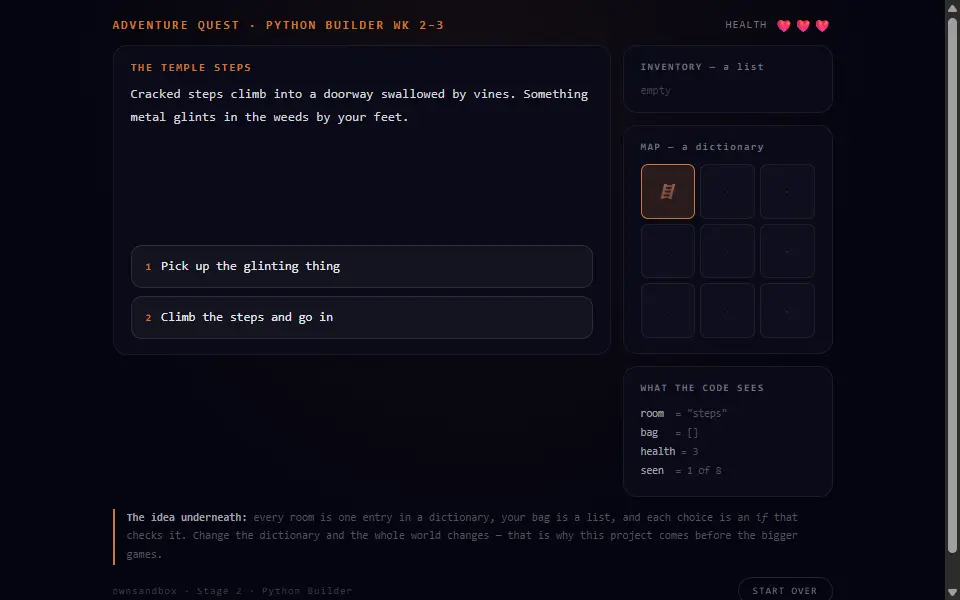
Adventure Text Game
Rooms, choices, inventory, combat. Story + logic + data structures.
Play a real oneAlgebra Visualizer
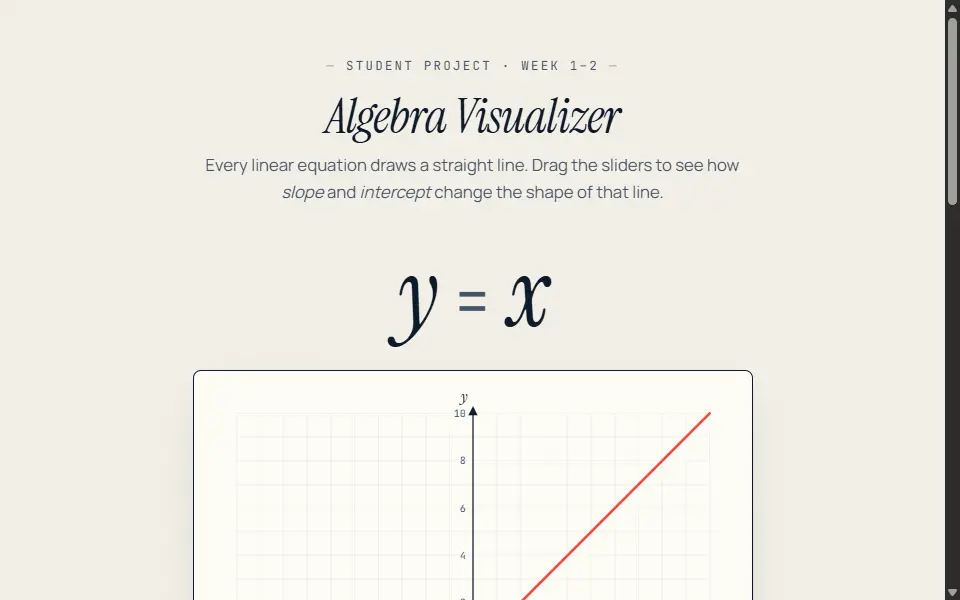
Plot equations. See y = mx + b as a LINE. Change the slope with sliders. Algebra becomes visual.
Play a real oneWeeks 5–8GAMES + PHYSICS
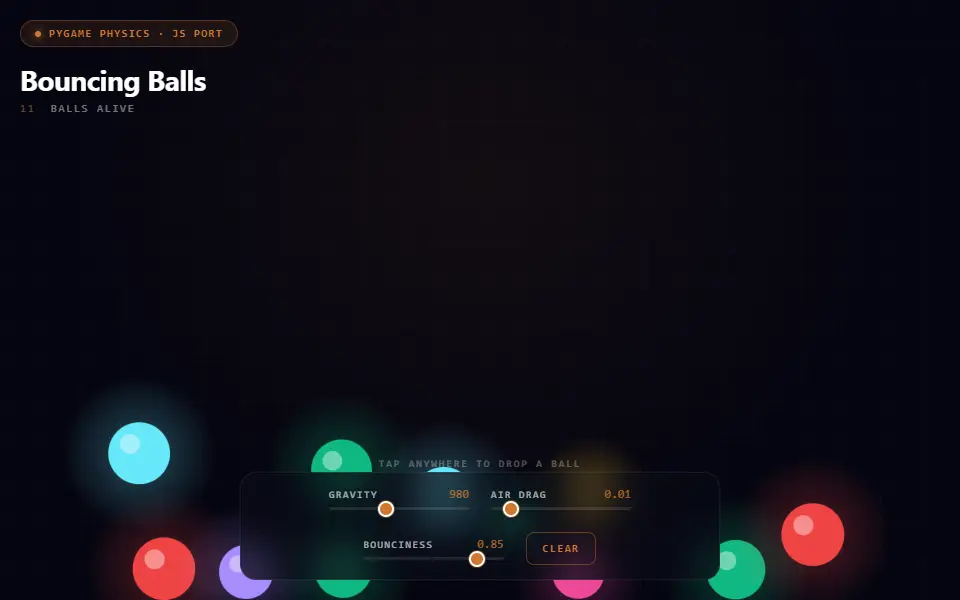
Bouncing Ball Physics
Pygame. Gravity, collision, friction. Sliders control everything.
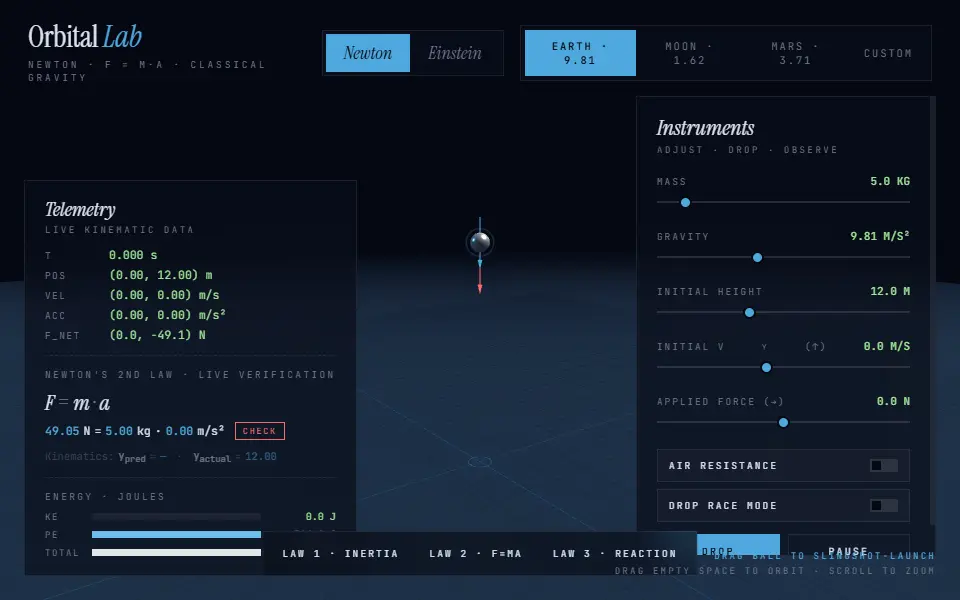
Play a real oneGravity & Motion Simulator
Code F = ma. Drop objects on Earth, Moon, Mars. Verify Newton’s laws with sliders.
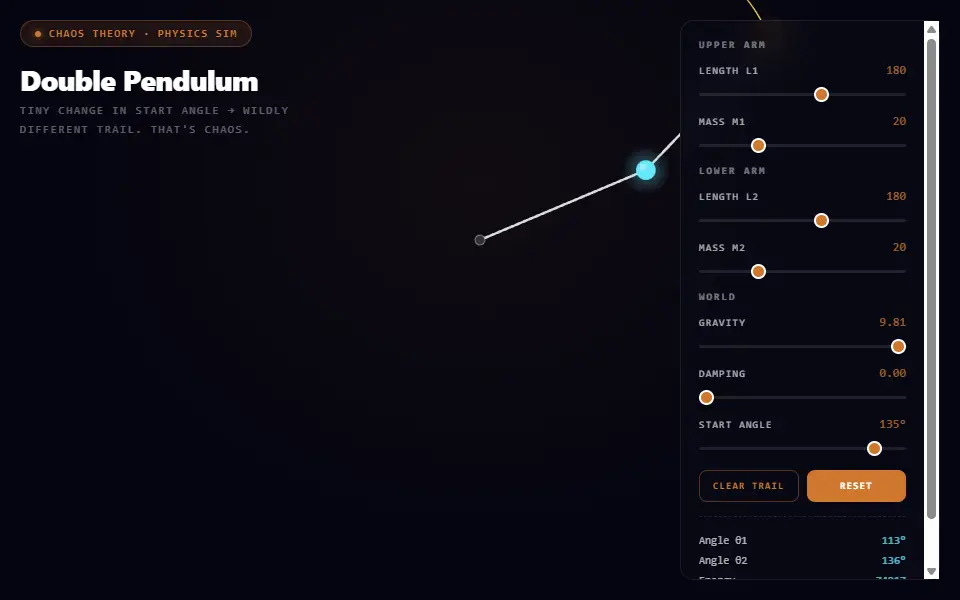
Play a real onePendulum Lab
Simple + double pendulum. Chaotic motion visualised — the moment physics gets beautiful.
Play a real oneWeeks 9–12WEB + 3D
First Website
Multi-page site. About, gallery, contact. CSS styling. LIVE on the internet.
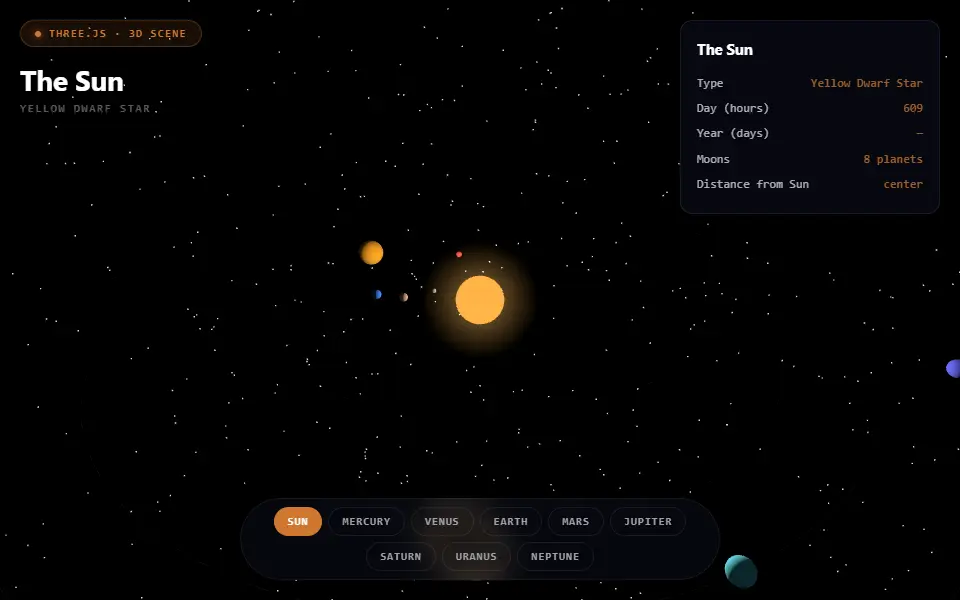
3D Solar System
Three.js. Planets orbit with real ratios. Camera controls. Their first 3D scene, on their URL.
Play a real one3D Racing Game
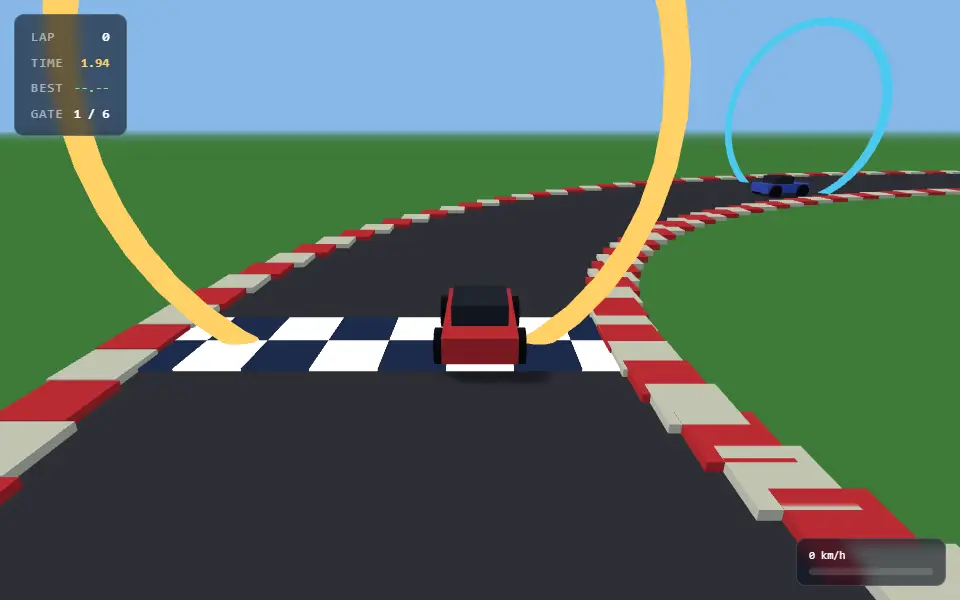
A car, a track and a lap timer. Acceleration, friction and a top speed written as ordinary arithmetic — no physics engine anywhere in the file.
Play a real oneWeeks 13–16AI + TEAM + SHOW DAY
AI Story Generator
OpenAI API. Generate stories by mood and topic — and understand what the model is doing.
Team Build (pairs)
Plan → build → review. A full project from scratch, together, on Git.
SHOW DAY
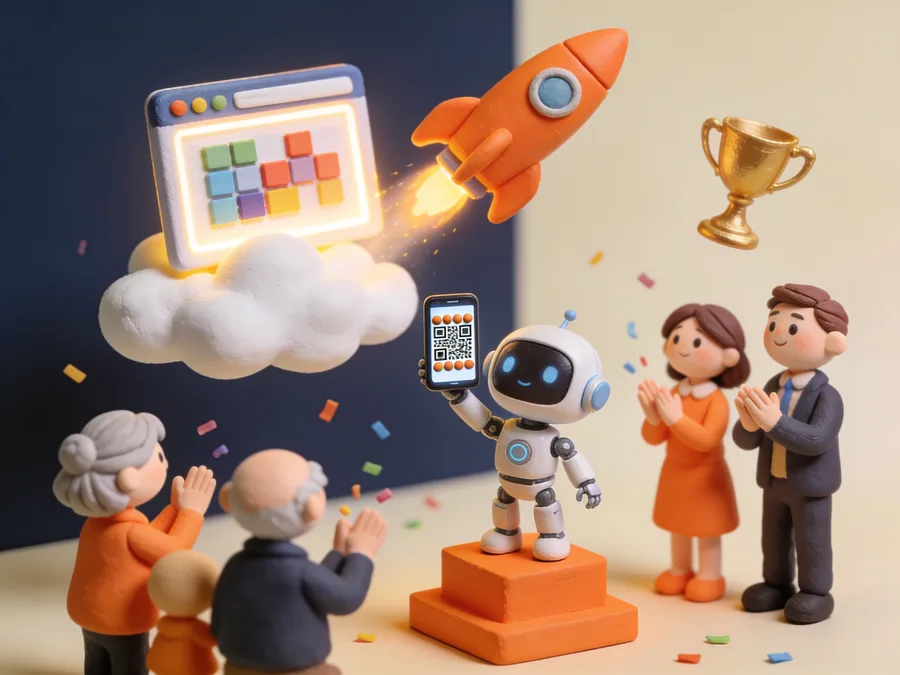
Present the three best projects to the family. Certificates. Track recommendation for Level 3.
What your child will ship
Live, on a real URL.
Tools & skills
The real thing, not a kids' version.
 PythonPython TurtlePygamematplotlib
 HTML/CSS
 Three.js
 OpenAI API
 GitHub
Maths + science woven in
Every project carries the maths and science its subject needs — coordinates and loops at Level 1, projectile physics and algebra at Level 2, probability and statistics in the AI track. Not a separate class. The same code.
The next rung
After Python Builder, most students go to
“She built her first Python game in week 2.” Not random YouTube tutorials, but a real curriculum with a teacher who knows her progress.
Questions about this course
- How much does it cost?
- The first class is free. After that you pay by the hour: ₹930 an hour in a small group (up to 4 kids) or ₹1,400 an hour for 1:1 — in the US, $20 or $30. Classes are three a week, one hour each, so a month is about 12 classes. You pay monthly and can stop anytime. Why that much: with at most 4 kids, each child gets about 15 minutes of the teacher every hour (in a class of 35 it is under 2), Ajay teaches every class himself, and your child finishes a real project every week or two.
- What are the class timings?
- Evenings after school, in your time zone. Every course is three 60-minute classes a week; the days in between are deliberate — that is when your child builds on their own, which is where most of the real learning happens. We pick the days and times with you after the free class.
- What if my child loses interest after a few weeks?
- It's the #1 parent fear — and we designed for it. Every session ends with "show and tell" where kids demo what they built. That ownership keeps them hooked. And if it truly isn't working, you are never locked in: you pay one month at a time and can stop anytime.
- Do I have to pay for a whole course up front?
- No. You pay month by month for the classes you take, and you can stop at the end of any month. There is nothing to sign up for in advance.
Not sure this is the right step?