

Level 4 · Capstone · Ages 15–18
CapstoneOne real product.
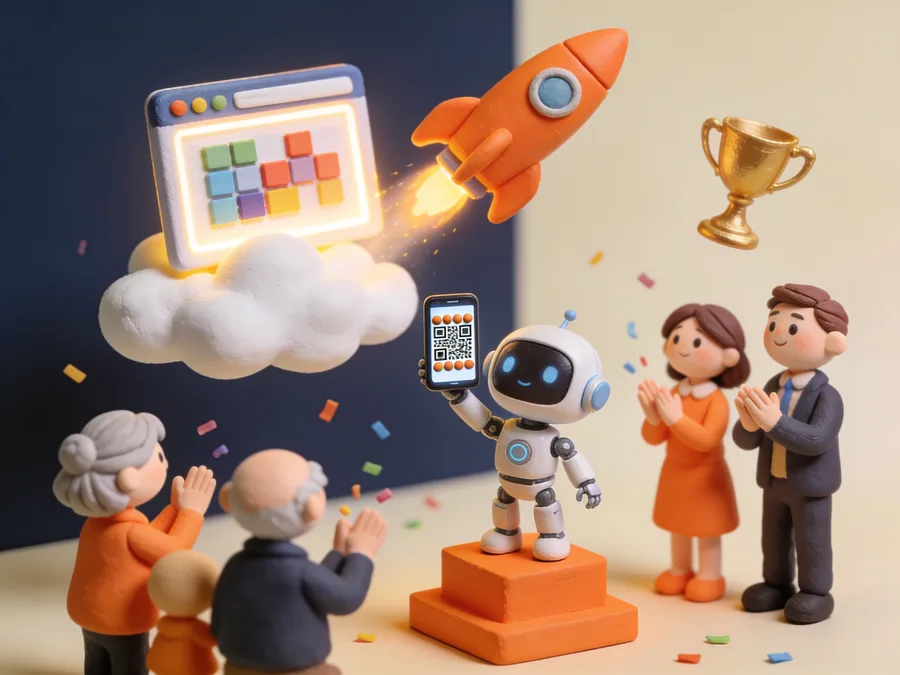
Your teenager will leave with one real product launched to real users, a merged open-source contribution, and a written portfolio — the exact artefacts college applications and first internships ask for.
- Live URL
- Open-source PR
Week by week · 12 weeks · 9 projects
What they build, when.
Weeks 1–2ALGORITHMS + DISCOVERY
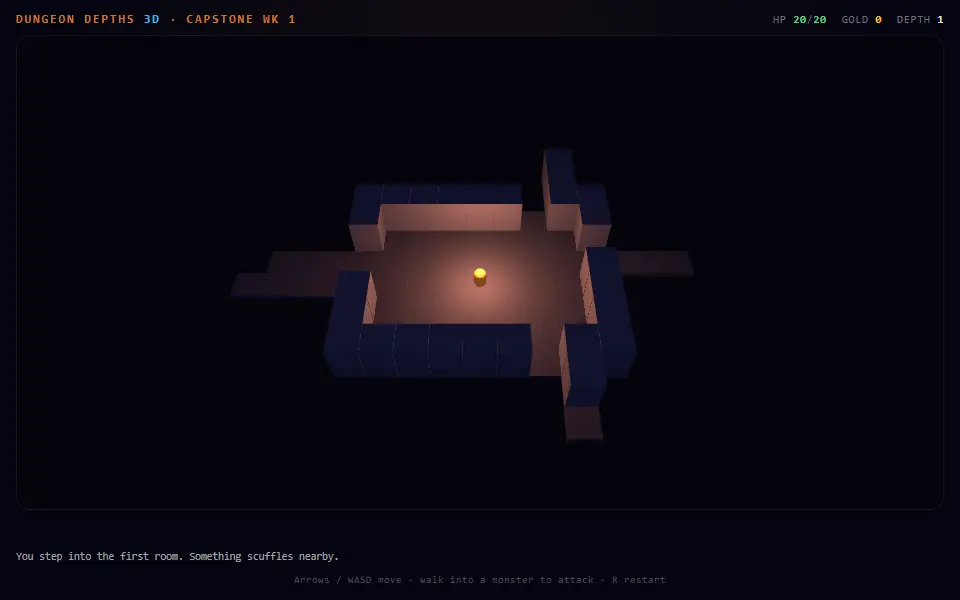
Dungeon Generator
Build a dungeon no one designed: rooms placed at random, corridors joined up, and monsters that work out their own route to you. Procedural generation, breadth-first search and Big-O, understood by building them.
Play a real oneProduct Brief
Pick a real user with a real problem — a teacher, a club, a family business. Interview them. Write the one-page brief.
Weeks 3–8BUILD
Data Model + API
PostgreSQL schema, a typed Node API, tests. The part of software nobody sees and everybody depends on.
The Interface
React + Next.js frontend. Component thinking, state, responsive layout. Reviewed weekly against the brief.
Auth + Payments
Real sign-in, real roles, and Stripe in test mode. The features that make it a product, not a project.
Weeks 9–10SHIP
Launch to Real Users
Deploy on a real domain. Hand it to the person from the brief. Fix what breaks. Read the analytics.
Open Source Contribution
Find an issue in a real project on GitHub, fix it, get the pull request merged. A public, verifiable credential.
Weeks 11–12PORTFOLIO + SHOW DAY
Portfolio + Write-up
A portfolio site and a technical write-up of the product — decisions, trade-offs, what they would do differently.
SHOW DAY
Present the product to the family and invited guests. Live demo, live Q&A. Recorded — for the college application.
What your child will ship
Live, on a real URL.
Tools & skills
The real thing, not a kids' version.
 TypeScript
 ReactNext.js
 Node.jsPostgreSQL
 Stripe
 GitHub
 Vercel
 OpenAI API
Maths + science woven in
Every project carries the maths and science its subject needs — coordinates and loops at Level 1, projectile physics and algebra at Level 2, probability and statistics in the AI track. Not a separate class. The same code.
Questions about this course
- How much does it cost?
- The first class is free. After that you pay by the hour: ₹930 an hour in a small group (up to 4 kids) or ₹1,400 an hour for 1:1 — in the US, $20 or $30. Classes are three a week, one hour each, so a month is about 12 classes. You pay monthly and can stop anytime. Why that much: with at most 4 kids, each child gets about 15 minutes of the teacher every hour (in a class of 35 it is under 2), Ajay teaches every class himself, and your child finishes a real project every week or two.
- What are the class timings?
- Evenings after school, in your time zone. Every course is three 60-minute classes a week; the days in between are deliberate — that is when your child builds on their own, which is where most of the real learning happens. We pick the days and times with you after the free class.
- What if my child loses interest after a few weeks?
- It's the #1 parent fear — and we designed for it. Every session ends with "show and tell" where kids demo what they built. That ownership keeps them hooked. And if it truly isn't working, you are never locked in: you pay one month at a time and can stop anytime.
- Do I have to pay for a whole course up front?
- No. You pay month by month for the classes you take, and you can stop at the end of any month. There is nothing to sign up for in advance.
Not sure this is the right step?